

Over the past 3 years, I’ve executed and overseen multiple 6-figure launches.
The highest-grossing one?
Over $650,000 in revenue.
And while every launch is different, the email strategy we use is almost always the same.
So today, I’m breaking down the exact 4-part framework we use for our own launches and for our clients - email by email.
Let’s get into it.
The 4 Parts Of Our Email Launch Playbook
Before we dive into the nitty gritty, here’s a high-level overview of what we’re going to be digging into:
Part 1: Pre-Launch Emails — Build anticipation before doors open
Part 2: Launch Emails — Drive sales during launch week
Part 3: Objection-Handling Emails — Convert high-intent fence-sitters
Part 4: Abandoned Cart Sequence — Recover people who almost bought
Each part has a specific job.
But they all play a key role in maximizing results.
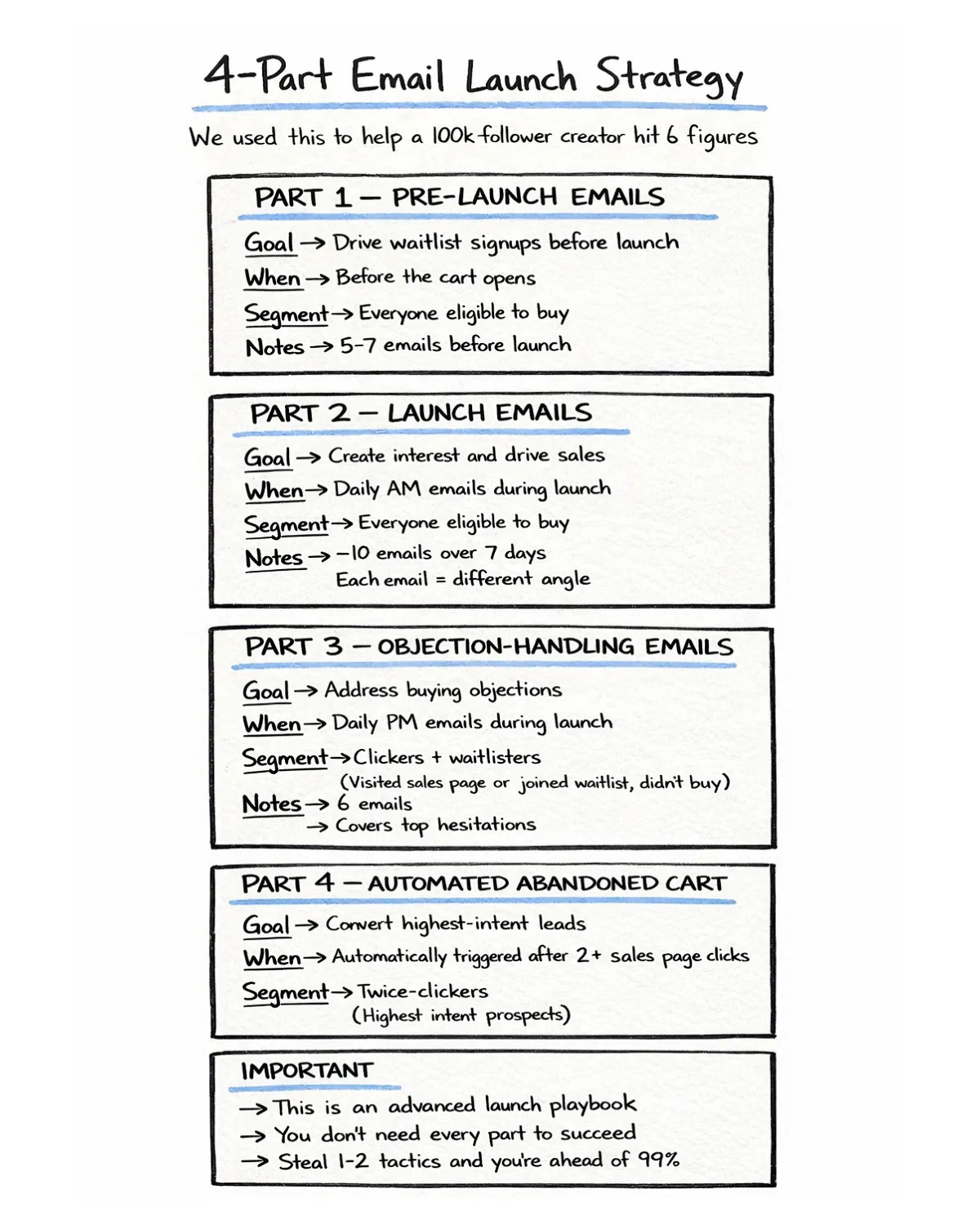
Now, let me break down each part.
Part 1: Pre-Launch Emails (5-7 emails)
The goal of your Pre-Launch Emails is to drive waitlist signups and build anticipation before the launch even begins.
Think about it.
If you launch cold, you’re catching your audience off guard.
You’re asking them to buy something out of nowhere without any anticipation or built-up demand.
But if you do your pre-launch right, a lot of people should already be ready to buy as soon as the actual launch begins.
The waitlist also creates psychological commitment - people who opt in are invested before they even see the offer.
When to send these emails
You can send these emails 1-2 weeks before your cart opens.
And you can send them consecutively (i.e. one email per day) or you can stagger them a little bit and send them every other day.
Personally, I prefer to send 5-7 consecutive emails the week before the cart opens.
The strategy
Sell the methodology, not the product.
Your Pre-Launch Emails should educate your audience on the approach or philosophy behind your offer.
By the time you open the cart, they should already believe in the method - so buying feels like the logical next step.
For example: If you’re launching a course on email marketing, your pre-launch emails might teach why email beats social, or why most email strategies fail.
But you’re not pitching the course yet.
Instead, you’re making the case for the worldview the course is built on.
Part 2: Launch Emails (10 emails over 7 days)
The goal of your Launch Emails is simple:
Drive people to your sales page and get as many of them as possible to buy your product.
Now, of course, you can do that in a bunch of different ways.
But these are our 10 “staple” themes we always go back to when building a Launch Sequence:
Announcement — Doors are open. Here’s what it is, who it’s for, and how to get it.
Bump — Short follow-up for people who missed the first email. “In case you missed it” type of deal.
Success Story — Feature one specific student or client transformation. Make it relatable and aspirational. Show the reader what’s possible.
Forward-Leaning Email — Paint the picture of life after the transformation. Help them visualize the future version of themselves (if they take action right now).
Bonuses Overview — Stack the value. Show everything they get beyond the core offer. Make the deal feel like a no-brainer.
Testimonial Roundup — Share a roundup of testimonials in one email. Different archetypes of people, different results. More proof = more trust.
FAQ Email — Answer the most common questions people have before buying your program.
Last Chance #1 — Last-day urgency begins. Cart closes soon. Remind them what they’ll miss if they don’t act.
Last Chance #2 — Reinforce scarcity or minimize the perceived risk. Add a new angle or reason to buy now.
Last Chance #3 (Final Hours) — Final push. Door closes tonight. This is often the highest-converting email of the entire launch.
When to send these emails
Our last launches are typically 7 days long.
So what we do is - we send an email every day of the launch (in the morning) and we double it (or triple it) up on the first and last day:
On the first day, we send emails 1 & 2
And on the last day, we send emails 8, 9, & 10
The rest of the days we just send 1 email.
Now, you might be thinking…
“Daniel… 10 emails is a LOT, isn’t it?”
But here’s the thing you need to realize:
Not everyone opens every email.
You need multiple touchpoints to reach as many people as possible in your audience.
Plus, each email serves a different purpose - speaking to a different buyer psychology, a different objection, etc.
And if I’ve learned anything is this:
There’s a direct correlation between the amount of emails you send during a launch and the amount of revenue you generate.
So, do with that what you will.
Part 3: Objection-Handling Emails (4 PM sends)
Alright, we’re getting into advanced territory here.
(99% of founders and creators don’t even know this is a thing!)
The goal of this next sequence is to address hesitations from your highest-intent prospects - people who’ve clicked on your sales page (or joined the waitlist during the pre-launch period) but haven’t bought yet.
These people have already shown interest.
But if they haven’t bought is because there’s something holding them back.
And that’s where these emails come in.
When to send these emails
As you probably remember, once the cart opens, you’re sending daily launch emails to your whole list each morning.
Which is why we want to wait until the afternoon/evening to send these.
(Yes, we also send these every day of the launch - except for Days 1 & 7 when we are sending multiple launch emails.)
Now, here’s the key thing to keep in mind:
You’re only sending these “extra” daily emails to people who’ve shown intent (not to your full list).
The strategy
Each product/offer comes with its own bag of objections.
But after selling all sorts of digital products (in a bunch of different niches), I can tell you there are 3 universal objections you always want to address:
Pricing — Reframe investment vs. cost - what’s the ROI of solving this problem? And what does it cost them to not solve this?
“Will it work for me?” — Show that this works for people like them and reduce the “I’m different” objection with hyper targeted examples.
Comparison to alternatives — Why this over other courses, coaches, or DIY approaches What makes your method different or better?
So, make sure to always cover these 3 bases.
Part 4: Abandoned Cart Sequence (Automated)
OK, we’re almost done here!
So the goal of this final sequence is to give your highest-intent, most engaged prospects a final nudge to buy.
And unlike your Objection-Handling Sequence, you only want to send your Abandoned Cart Emails to people who’ve clicked on your sales page (without buying) at least twice.
It’s hyper targeted.
Which is why a well-executed Abandoned Cart Sequence can help you get an extra 10-20% of sales you’d likely lose otherwise.
When to send these emails
These emails are meant to be sent automatically.
Here’s how it usually works:
Somebody clicks on your sales page for the second time
You put them on hold for 20-30 mins (to see if they buy)
If they don’t buy, they’re added to the sequence and the follow-ups begins.
The other cool thing is:
Once you have this system set up, you can re-use for all your future launches with minimal tweaks.
The strategy
Our Objection-Handling Sequence typically has 3 emails (with the third email changing based on the specific reason why the prospect is on the fence).
Here’s a quick breakdown:
Email 1: Nudge Email (Story-Based)
This first email aims to get people to buy by telling a story:
Why you created this
A moment of realization
The problem you were trying to solve
And it reminds them that they showed interest, with a link back to checkout.
Email 2: Survey Email (Self-Segmentation)
The whole purpose of this email is to gather data (not to sell).
Basically, we’re asking the reader:
“Hey, what’s holding you back?”
But instead of just leaving it up for them to respond manually, we include 3 clickable links - each one representing a common objection:
“It’s the price”
“I don’t have time right now”
“I’m not sure it’s for me”
When they click, they self-segment into a more targeted follow-up email.
This works very well because they are the ones telling what’s holding them back.
Email 3: Targeted Objection Emails
Lastly, based on which link they clicked, you send them a final, hyper-targeted follow-up email:
“It’s the price” → ROI breakdown, payment plan options, cost of inaction
“I don’t have time” → Time-saving angle, quick wins, “less time than you think” framing
“I’m not ready” → Handle the limiting belief directly. Waiting often makes the problem worse. Action creates readiness.
Phew, we’ve covered a lot!
Now, as you can see, this is a pretty comprehensive playbook.
And if you’ve never executed a launch of this caliber before, the process can easily get overwhelming.
So I’ve created an AI mega-prompt to help you with that.
The AI Email Launch Strategist
Copy/paste this prompt in your favorite LLM/AI tool.
(No need to fill in any information.)
Your AI will interview you, gather all the details about your offer and your launch timeline, and then map out your entire launch email strategy - all 4 sequneces with suggested themes, cadence, etc. based on the framework I just walked you thorugh.
Here you go:
