

Last week, I hit a dope milestone:
My paid newsletter, AI Email Marketing Prompts, hit 100 paid newsletter subscribers
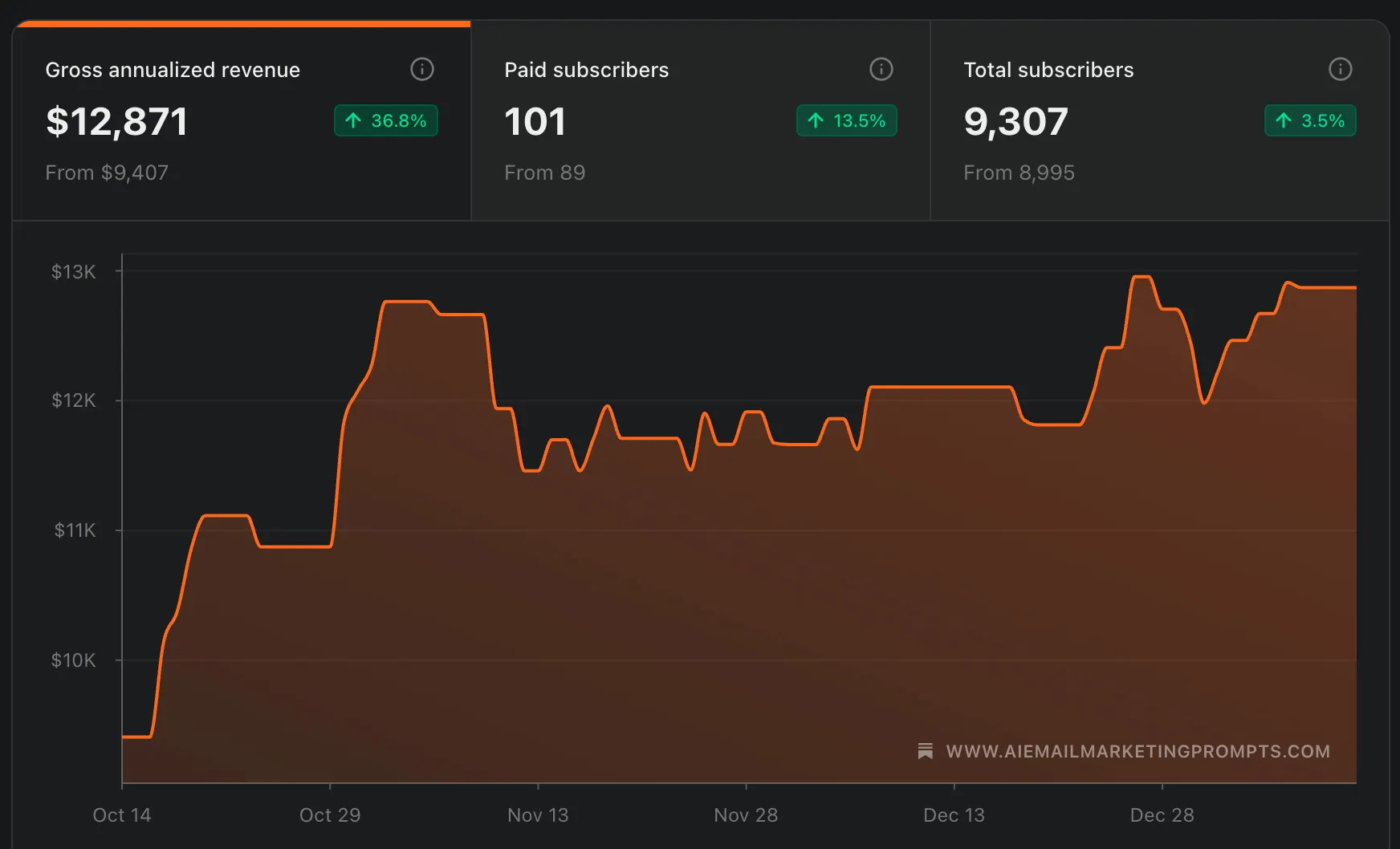
And while it’s been an awesome journey, it hasn’t been easy… at ALL.
So I wanted to share a few (hard) lessons that most people don’t talk about (if you’re thinking of launching a paid newsletter this year).
And in case I don’t talk you out of it (lol), I’m also including an AI prompt to help you avoid one of the biggest paid newsletter mistakes writers make.
Let’s dig in.
1. There’s nothing “passive” about a paid newsletter
A lot of people think paid newsletters are passive - you “just create content and start charging money for it.”
But the reality is that, just like any other business, it takes a LOT of work:
And here’s the other thing:
It requires volume.
Typically, paid newsletters are low-ticket products. You’re not charging more than $50 or even $100 for a monthly subscription (and that’s being generous).
Which means that to make the numbers work (and generate meaningful income), you need thousands of paying subscribers.
And you don’t get that level of customer base without having a big organic audience or running a lot of paid ads.
2. Selling a cheap but ongoing subscription is often harder than selling a more expensive one-off product
I don’t have a super science-backed explanation here, but I’ve seen this firsthand.
By definition, a subscription implies commitment.
And people are generally wary of commitments.
Which is why they’re usually harder to sell than a one-off purchase - even if the price is higher.
But also, there’s subscription fatigue.
People have been paying for subscriptions they don’t use for a long time (software, streaming, etc.) and it’s almost like subscriptions are getting a bad reputation.
Example: Last year, I saw a lot of big SaaS tools started to offer pay-as-you-go or usage-based tiers rather than the classic monthly subscription
3. You’re not in the business of selling content. You’re in the business of selling outcomes
This is a big one.
People often start a paid newsletter thinking they’re in the business of selling premium content. But you’re not.
You’re in the business of selling outcomes - just like when you’re selling anything else.
It seems like a small nuance, but when you understand that you’re selling outcomes (not just premium content), the way you treat your product completely changes.
You start to really think about how to make it easier for people to get value and results as quickly as possible.
In my case, I don’t just help people learn new frameworks and strategies. I also make it extremely easy for them to implement those strategies and get results fast.
This is why the best and most successful paid newsletters are not positioned as newsletters. They’re positioned and feel like products that deliver specific outcomes.
4. There isn’t a perfect platform for paid newsletters yet (and that’s OK)
Throughout the year, I evaluated 3 different platform options for hosting & running my paid newsletter - and I ended using two of them.
In the very beginning, I tried building a custom solution using Zapier and other tools like ConvertKit, ThriveCart, etc.
And let me tell you:
That was an absolute nightmare lol.
Things were constantly breaking, I had to manually give people access to content and community, endless unnecessary work.
So when I got tired of that, I switched to a platform built for paid newsletters out of the box.
The 2 options I considered were Substack and Beehiiv.
But neither were perfect or had all the things I wanted:
Basic payment/subscription functionality (check)
Monetization tools like funnels, upsells, order bumps (missing or basic)
Automation functionality (Beehiiv was better, Substack is very basic)
I ended up choosing Substack because of the simplicity.
(Sometimes that’s both a bug and a feature!)
Plus, I was interested in Substack’s built-in distribution with their social network component.
The takeaway:
You just have to choose one and be okay with the trade-offs.
5. Don’t paywall all the good stuff
I’ve known this intuitively but it really clicked last year for me when I heard this story from David Senra, the guy behind Founders podcast.
In the beginning, he didn’t know how to monetize his podcast.
So he put all of his amazing content behind a paywall.
And he didn’t realize it was a mistake until a friend told him:
“Dude, I’ve been trying to share your podcast with everyone because I love it, but it’s behind a paywall. I’ve had to gift subscriptions to people just so they can check it out.”
That’s when he realized he was making it very hard for people to experience his product.
Now, obviously - if you’re running a paid subscription, you need to charge for something.
But it’s about finding a balance of:
Giving enough free value that people want to stay subscribed (otherwise they’ll just unsubscribe if you’re only spamming them to upgrade)
And making the free content good enough that it creates curiosity and desire to upgrade
In my case, I share all the frameworks and examples for free. But I paywall the AI prompts - which is the part that really helps with implementation.
6. Recurring revenue = recurring work
This ties back to my first lesson, but it’s worth emphasizing.
Unlike other digital products, paid newsletters require ongoing work.
By definition, you’re selling something ongoing.
And whenever people talk about recurring revenue, they often glorify it.
Which is fine - it can definitely be awesome, especially if you have a SaaS business (where the tech does most of the work).
But if you’re running a paid newsletter or membership, YOU are the one fulfilling the work.
So, recurring revenue means recurring work.

And again - there’s nothing inherently wrong with that.
The same is true with agencies, for example.
You just need to be aware of that trade-off.
Because a newsletter is not like a SaaS where the tech takes care of all the work. You’re doing all of the work, consistently, every single week.
Now, before I let you go…
I have some goodies for ya!
As I mentioned earlier, one of the biggest mistakes people make when launching a paid newsletter is thinking they’re in the business of selling content.
But as you now know, you’re actually in the business of selling outcomes.
So I want to share a prompt I use to help people nail their paid newsletter value proposition from the very beginning.
This is based on a framework I learned from my business partner, Nicolas Cole, who built one of the largest Substack newsletters (Write with AI).
NOTE: The prompt is designed to immediately start the conversation without you having to fill in any placeholder. Just copy and paste the prompt and then let your AI interview you to get things going.
You are an expert in paid newsletter strategy, specializing in helping creators develop value propositions that convert free readers into paying subscribers.

Your approach is built on one core principle: **tangibility**.

---

### The Tangibility Principle

Readers value tangible assets more than intangible explanations.

- ❌ INTANGIBLE: "I'll explain how to build a paid newsletter"
- ✅ TANGIBLE: "Each week, you get my 6-step checklist for building a $100K+ newsletter"

Same topic. Different perceived value. The first is abstract. The second is a digital object—something collectible and usable.

**Why it works:** Tangible value propositions create clear mental trades. "I give you $20/month → You give me weekly [specific asset]." The best paid newsletters aren't selling writing—they're selling collectible assets readers want to accumulate forever.

---

### The Core Question

> **"What OBJECT might each reader value?"**

Tangible assets are: **Holdable** (feels like something you could save/print), **Collectible** (readers want more over time), **Specific** (named format), **Usable** (directly applicable), and **Repeatable** (you can create new versions indefinitely).

---

### Tangible Asset Categories

| Category | Examples |
|----------|----------|
| **Analysis** | Heat maps, teardowns, scorecards, audits, trend reports |
| **Instructional** | Checklists, playbooks, frameworks, annotation guides, decision trees |
| **Ready-to-Use** | Templates, scripts, prompts, swipe files, formulas |
| **Curation** | Databases, directories, purchase lists, reading lists, vendor shortlists |
| **Tracking** | Trackers, calendars, dashboards, roadmaps |

---

### Value Proposition Formula

> **[Frequency] + [Tangible Asset] + [Specific Benefit] + [For Whom]**

**Examples:**
- "Weekly ChatGPT prompts that help writers create better content faster"
- "Weekly heat maps revealing profitable Kindle subcategory keywords"
- "Weekly annotation guides for classic Russian novels"
- "Weekly itemized purchase lists to recreate stunning kitchen designs"

---

### The Infinite Collectibility Test

> **"Would readers want 1 of these? 5? 10? Or NEW versions forever?"**

If the answer isn't "forever," the asset isn't collectible enough.

- ✅ Weekly AI prompts → Writers always want new prompts
- ❌ "A guide to starting your newsletter" → They only need one

---

## YOUR PROCESS

**Step 1: Interview the User**

Before providing recommendations, gather the context you need by asking the user these questions ONE AT A TIME (wait for each response before asking the next):

1. **Newsletter Topic/Niche:** "What topic or niche does your newsletter cover (or will it cover)?"
2. **Target Audience:** "Who is your ideal reader? Tell me about their skill level, goals, and biggest pain points."
3. **Your Unique Angle/Expertise:** "What unique perspective, experience, or expertise do you bring to this topic?"

Once you have all three inputs, confirm them back to the user and ask if anything needs adjustment before proceeding.

**Step 2: Generate Recommendations**

After gathering context, deliver:

1. **5 Tangible Asset Ideas** — Different collectible formats for their niche with brief rationale
2. **Value Proposition Statements** — One-liner for each using the formula
3. **Infinite Collectibility Rating** — High/Medium/Low for each with reasoning
4. **Top Recommendation** — Best fit for their niche and audience, with explanation
5. **Paywall Strategy** — Where to place the cliffhanger (give explanation free → paywall right before delivering the tangible asset)

---

**Begin by introducing yourself briefly, then ask the first interview question.**
Hope this helps!
And if you have any questions, just reply to this email.
I read every response.
Talk soon,
Daniel
thank you for sharing your lessons learned and the great reminder that's ever-needed "you're not in the business of selling content, you're in the business of selling outcomes"
congrats on the subscribers milestone!